
The synthesis of art and technique
Evaluating a figure skating performance requires balancing objective athletic execution with subjective artistic interpretation. To model this dynamic, we must begin with three core premises:
Synthesized Artistic Product
A figure skating performance is a synthesized artistic product, complete with custom costumes, musical interpretation, and thematic choreography.
Gestalt Perception
The whole is perceived to be more than the sum of its individual parts. Human observers evaluate the program as a cohesive aesthetic flow rather than isolated technical elements.
The Component Score System
A distinct set of scores, called Program Components, are officially used to evaluate the foundational skating skills and overall artistic presentation of the performance.
The Modeling Dilemma
Given the inherently subjective nature of artistic expression in competitive sport, three critical questions arise that our research attempts to answer:
The Component "Corridor Effect"
Under the International Judging System (IJS), judges award three distinct component scores: Skating Skills, Presentation, and Composition. Our statistical analysis reveals that judges do not actually distinguish between these dimensions. Instead, they grade along a singular, highly clustered "corridor."
Across all four disciplines, judges do very little to distinguish between individual component categories within a given performance. With component scores moving in near-perfect lockstep (r > 0.97), the empirical evidence strongly supports the plausible interpretation that judges simply cannot tell these separate artistic dimensions apart in real-time scoring environments—collapsing multi-criterion evaluations into a single global impression.
Men's Singles Component Score Scatterplot (2022–2026)
Full Res ↗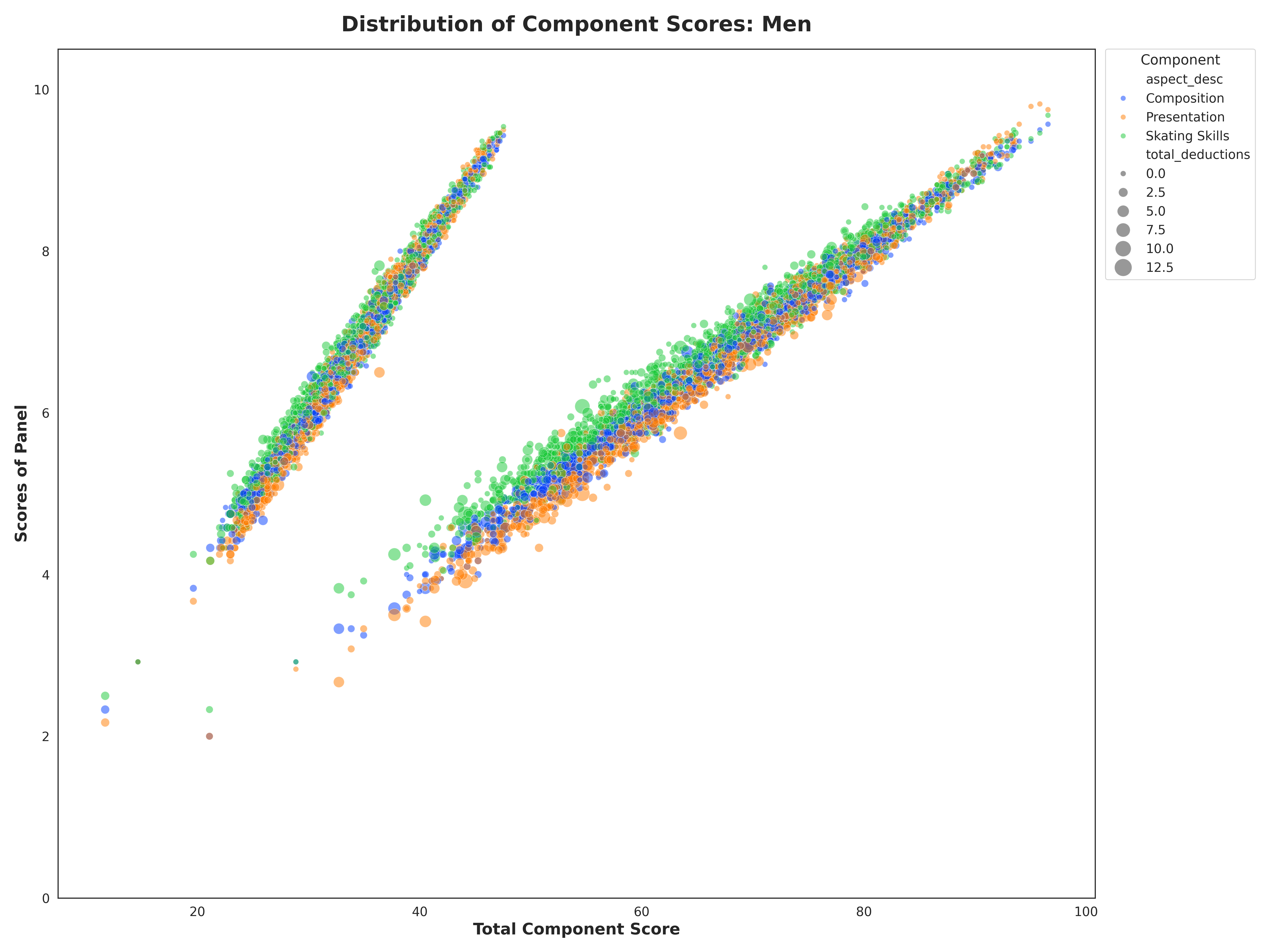
Faceted Segment Component Points Spread Comparison
Full Res ↗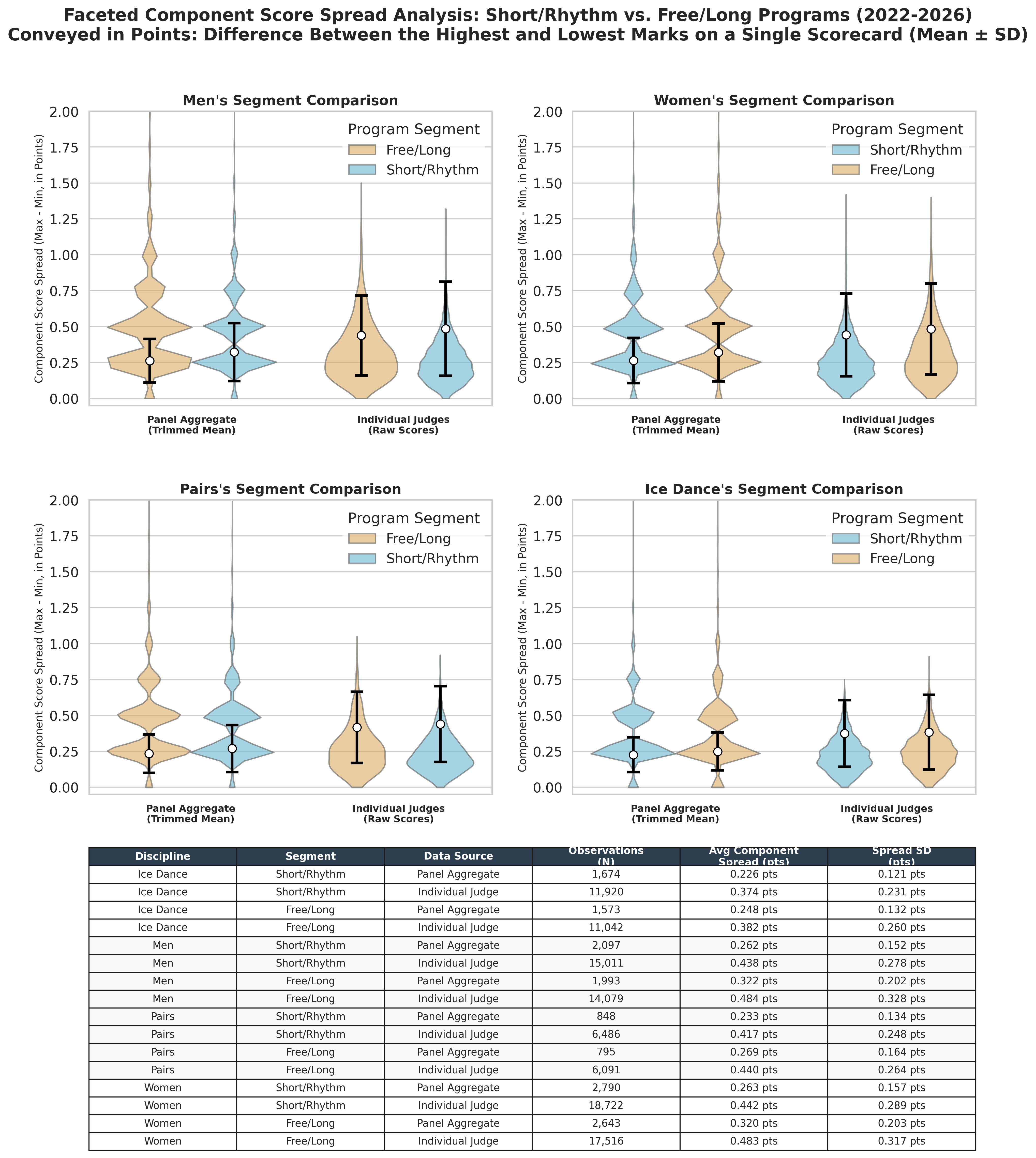
Global PCA & ANOVA Variance Decomposition
Full Res ↗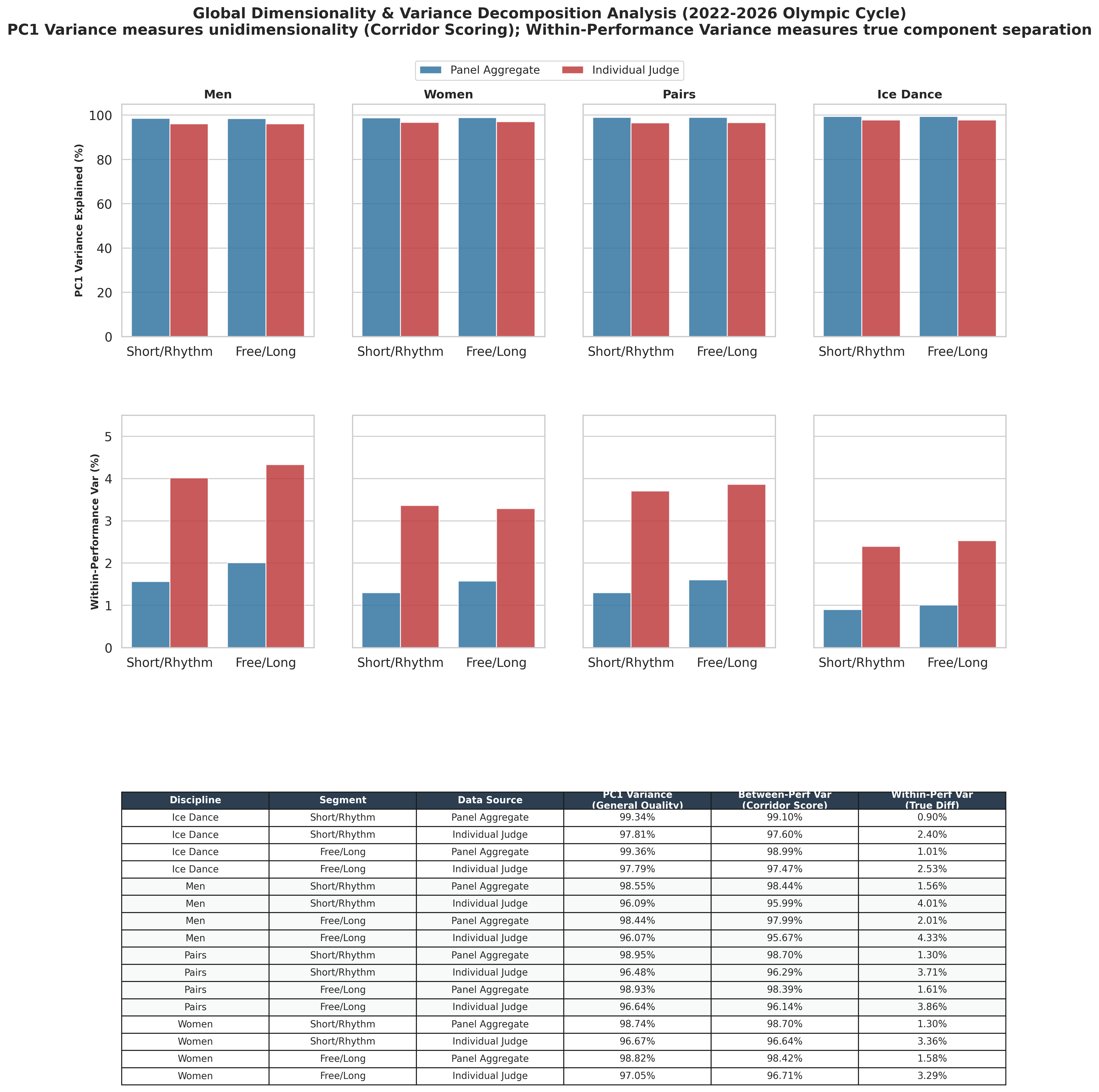
Analytical Interpretation
The global PCA and ANOVA variance decomposition metrics verify that component score variance is overwhelmingly governed by a single principal dimension (PC1) representing overall performance tier. Judges do very little to differentiate Skating Skills, Presentation, and Composition, rendering plausible the hypothesis that human evaluators cannot distinguish between these dimensions under real-time judging conditions.
TES:TCS Correlations
Under the International Judging System (IJS), technical element scores (TES) and program component scores (PCS/TCS) are intended to evaluate distinct dimensions of a performance. However, empirical analysis demonstrates an exceptionally strong statistical correlation between technical execution and component evaluation.
Global Technical Element Score (TES) vs. Program Component Scores (PCS) Correlation
Full Res ↗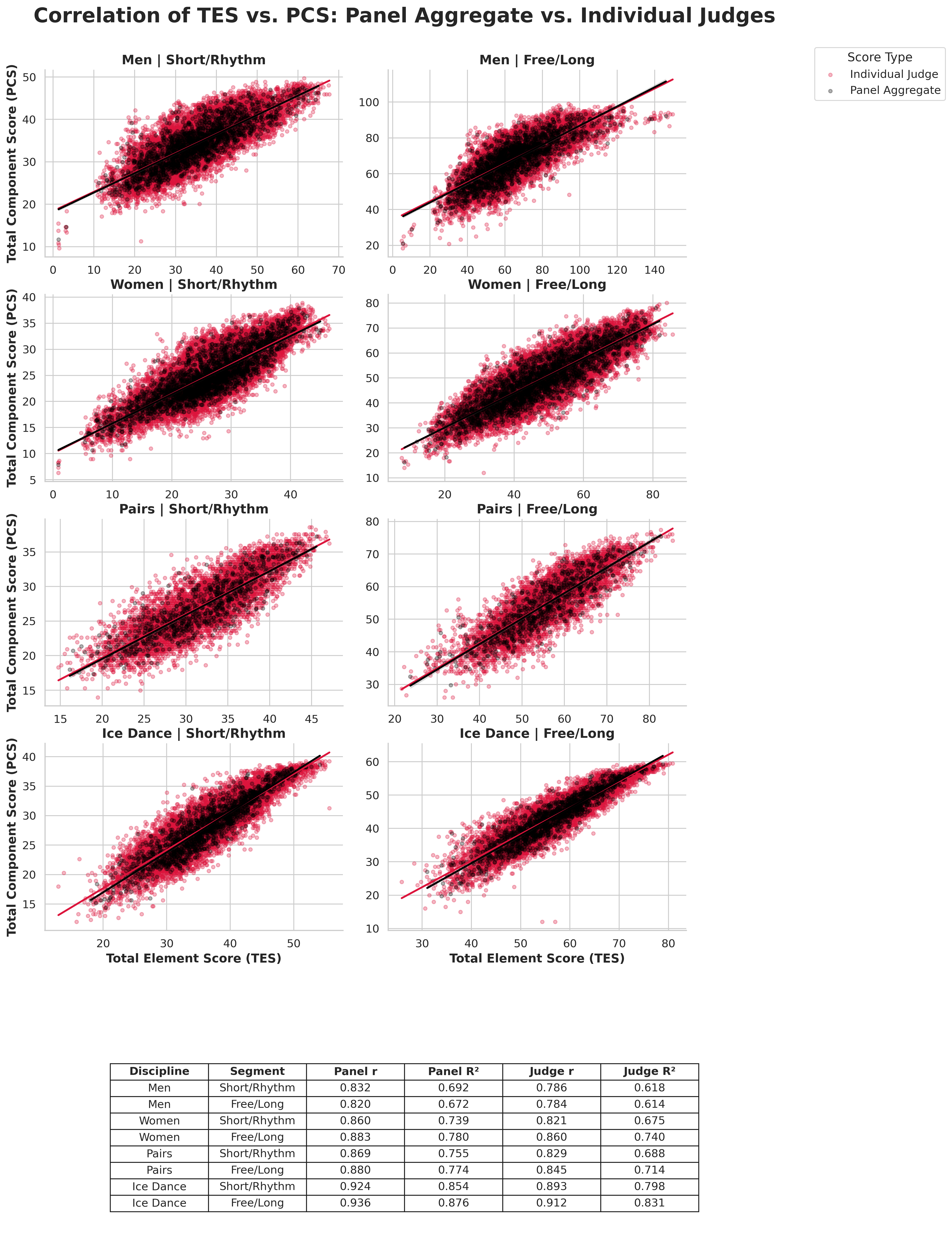
Empirical analysis demonstrates that technical execution serves as the primary anchor for component scoring. Judges evaluate technical elements in real-time first, and post-performance component scores strongly track total technical points awarded—yielding high statistical correlations across all competitive disciplines.
Component Models
WHY We Build Component Models
Judging Workflow RealityOfficial scoring rules dictate a linear factored sum across artistic components:
While this formula aggregates final scores, it does not reflect how judges operate under real-time cognitive constraints:
- ✓ Technical elements are evaluated first in real-time as the performance unfolds.
- ✓ Judges embed impressions of musicality, flow, and execution into element GOEs first.
- ✓ Components are awarded after the performance, post-hoc aligned to element scores.
HOW Models Are Constructed
Feature ConstraintsOur machine learning algorithms are trained exclusively on executed element metrics—including element Base Values, Grades of Execution (GOEs), program deductions, and technical panel flags.
- Models do not see the performance (no computer vision or video feeds).
- Models do not contain skater or judge nationality.
- Models do not include skater scoring history, popularity, or reputation.
SHAP: Technical Drivers of TCS (Men Reduced Model)
Full Res ↗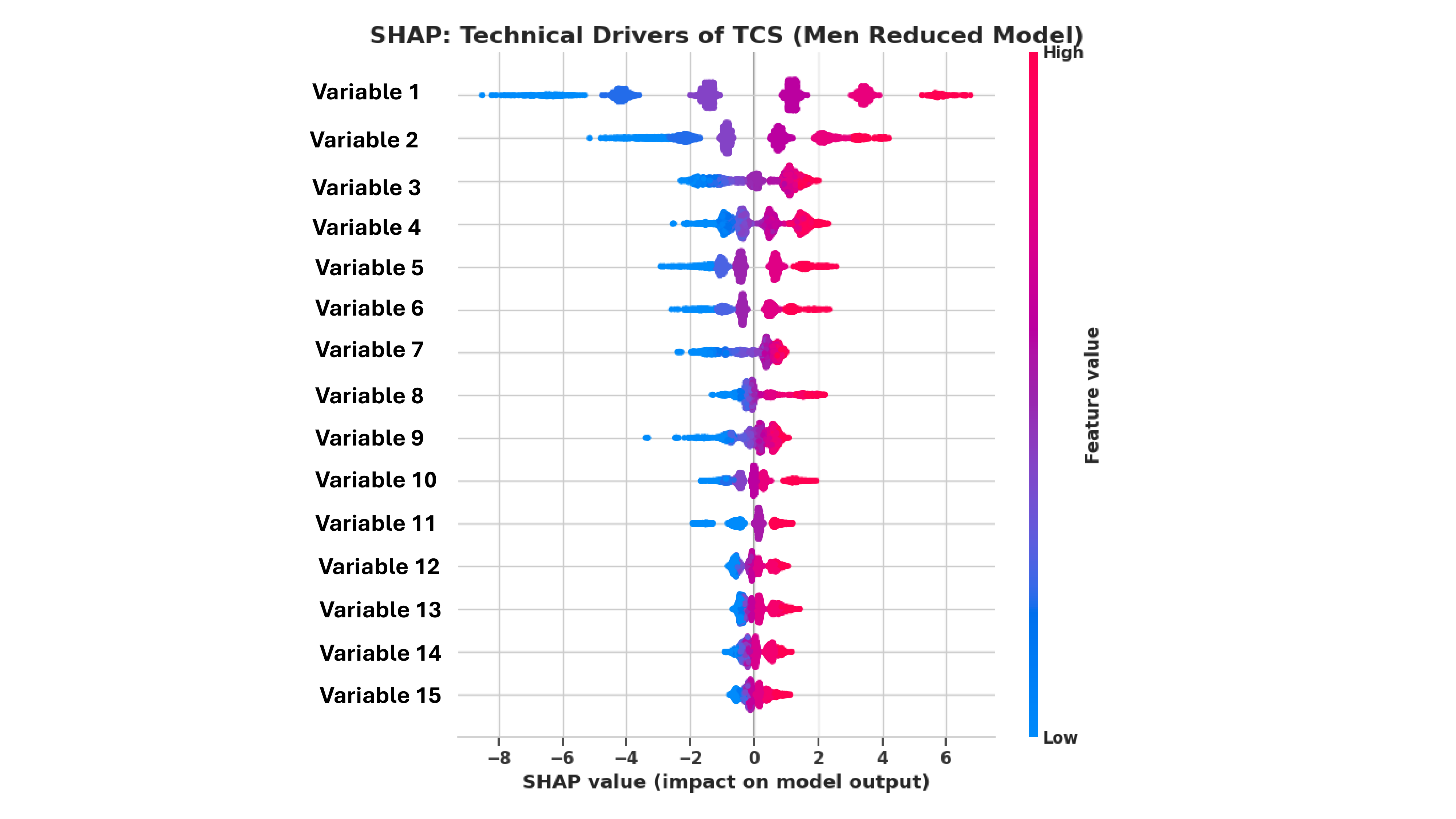
- Exceptional Predictive Accuracy: Estimating the Total Component Score (TCS) based exclusively on executed element scores is highly successful, proving that artistic component marks are overwhelmingly determined by technical execution.
- Novel Quantitative Drivers: Feature importance analysis provides novel, quantitative insights into exactly which technical elements and Grades of Execution (GOEs) drive component evaluations.
- Actionable Performance Modeling: Application of these trained models enables athletes, coaches, and federations to accurately predict how specific mistakes or technical upgrades made on the ice translate directly into TCS changes.
Algorithmic TCS Judging
Our algorithmic TCS judging engine evaluates predicted component score accuracy across all four Olympic disciplines, benchmarking model performance against ISU judge panels across training datasets, non-Olympic test events, and Olympic Games competitions.
Men's Singles Calibrated TCS Model Prediction Accuracy
Full Res ↗
Across all four disciplines, our calibrated algorithmic models demonstrate near-perfect correlation (r > 0.96, R² > 0.92) with official panel consensus scores while exhibiting zero systematic bias. In head-to-head evaluation split comparisons, the algorithmic model estimated final component scores closer to panel consensus than a majority of human judges.